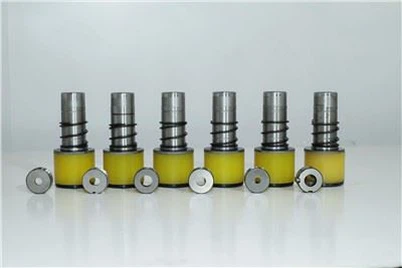
What Is The Busbar Processing Machine's Non-indentation Bending Die?
Leave a message
The busbar processing machine bending non-indentation mold is an important tool for busbar processing. The following is an introduction from the aspects of its structure, working principle, characteristics and application:

Structural characteristics
Mold material: high-quality mold steel, such as Cr12MoV, etc. This material has high strength, high hardness, good wear resistance and toughness, can withstand the huge pressure and friction during the busbar bending process, and extend the service life of the mold.
Surface treatment: The mold surface is finely ground and polished, and the roughness is extremely low. At the same time, surface treatment processes such as hard chrome plating may be performed to further improve the surface hardness and finish, and prevent scratches and indentations on the busbar during the bending process.
Working principle
The busbar is placed on the positioning block of the lower die, and the position of the busbar is accurately determined by the positioning block. The upper die moves downward under the action of the press, and the pressing block presses the busbar tightly against the die, and then the busbar is gradually bent into the desired shape through the specific shape and angle of the die. During the entire bending process, the various components of the mold work together to ensure that the busbar is subjected to uniform pressure and friction, thereby achieving a bending effect without indentation.
Performance Advantages
Non-indentation processing: This is the biggest advantage of this mold, which can ensure that the busbar surface is smooth and flat without any indentation or damage. This is very important for the electrical performance and appearance quality of the busbar, especially in some occasions where the quality of the busbar is high, such as power substations, switch cabinets, etc.
High-precision bending: The design and manufacturing precision of the mold is high, which can ensure the bending angle and dimensional accuracy of the busbar. Generally speaking, the error of the bending angle can be controlled within ±1°, and the dimensional accuracy can reach ±0.5mm, which meets the requirements of various complex busbar processing.
High efficiency and energy saving: Due to the reasonable structure of the mold, it can effectively transmit pressure during the bending process, reduce energy loss, and improve processing efficiency. Compared with traditional bending molds, it can save 20% - 30% of processing time and reduce energy consumption by 15% - 20%.
Long service life: High-quality mold materials and reasonable structural design make the mold have high wear resistance and fatigue resistance. Under normal use, the service life of the mold can reach 50,000 to 100,000 times, reducing the frequency of mold replacement and reducing production costs.
Application fields
Power industry: widely used in busbar processing of power equipment such as substations, power plants, switch cabinets, etc. Whether it is a rectangular busbar, a circular busbar or a special-shaped busbar, it can be bent with high quality through this mold to ensure safe and reliable power transmission.
Electrical equipment manufacturing: In the manufacturing process of electrical equipment such as transformers, distribution boxes, and distribution cabinets, the busbars need to be bent in various shapes and angles. The non-indentation mold can meet the strict requirements of these equipment for the processing quality of the busbars and improve the overall performance and reliability of the equipment.
Other fields: Some electronic equipment, communication equipment and other fields that have high requirements for conductive properties and appearance quality will also use busbar processing machine bending non-indentation molds to process busbars to ensure product quality and performance.
For more information about our products please contact us:
Whatsapp:+86 132 5612 1372
Email:lisa@busbarchina.com